What the Core Technology Fee actually costs an EU studio
Apple's Core Technology Fee is €0.50 per first annual install above one million. Apple estimates under 1% of developers pay it. Here's whether your studio is one of them.
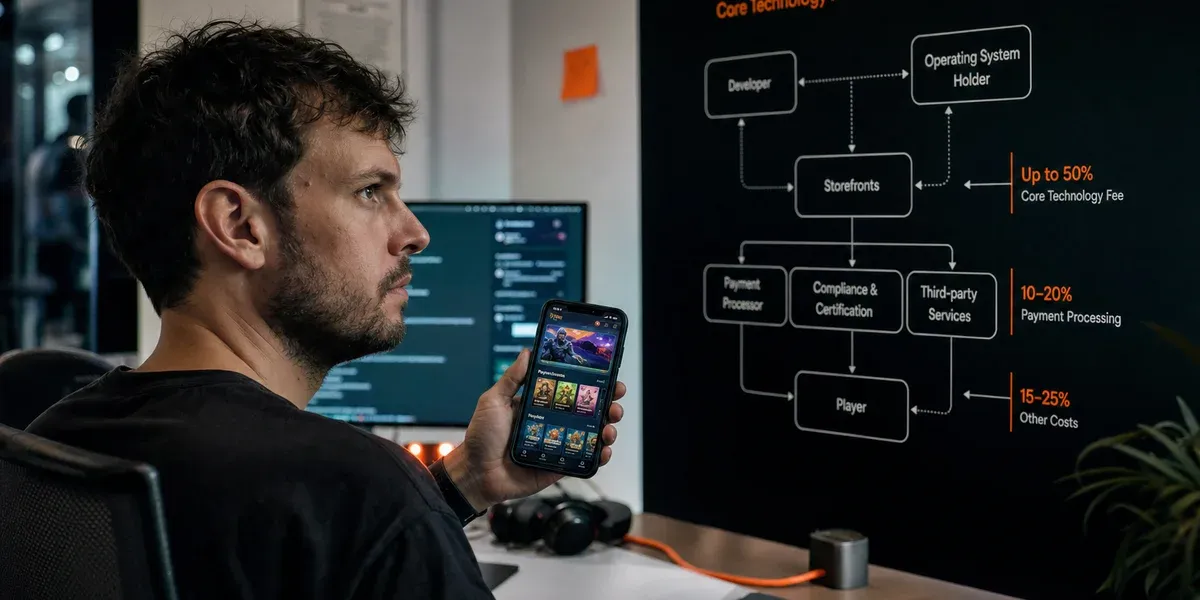
If you’ve read the headlines about the DMA forcing iOS open in the EU, you’d be forgiven for thinking the era of the 30% cut is over and a cheaper distribution path is just sitting there for the taking. The reality is more interesting, and more conditional. Apple’s answer to the regulation was a new line item — the Core Technology Fee (CTF): €0.50 per first annual install above a one-million-install threshold for the developer’s own apps. But for an operator running an alternative marketplace, that math is harsher: marketplace operators pay the CTF on every first annual install, with no million-install free tier at all. The first question a studio should ask is not whether alt-store distribution is cheaper. It is whether the CTF reaches them at all, and for the large majority the answer is no.
This piece is the spreadsheet, not the panorama. If you want the full lay of the land — which stores exist, what the DMA actually changed, where the channel is heading — we wrote that in the state of alternative app stores in 2026. Here we’re doing two things: establishing whether the fee applies to your studio, and, if it does, working out when it’s worth paying and when it quietly torches your unit economics. This is the iOS side of the ledger; for the Android equivalent after Google’s June 2026 fee changes, see what Google Play’s new billing-choice rate card actually costs.
How the Core Technology Fee is structured
The CTF is Apple’s way of charging for access to its developer tools and platform even when a download doesn’t pass through the App Store’s payment rails. The shape that matters:
- It’s €0.50 per first install per year, per user, per app. A reinstall by the same Apple Account inside the same 12-month window doesn’t trigger it again; an app update doesn’t trigger it. It’s tied to the first annual install.
- For a developer distributing their own app under the alternative business terms, the first one million first-annual installs in the EU are free; the CTF applies only above that.
- For the operator of an alternative marketplace, there is no free tier. The marketplace pays €0.50 on every first annual install it serves, from install number one.
That asymmetry is the whole story. A single hit app from a large studio might never reach the threshold where the CTF bites on its own distribution. A marketplace that aggregates thousands of mid-size titles is paying from the very first download, and someone in that chain has to absorb it.
Who actually pays it: Apple says under 1% of developers
Before any arithmetic, settle whether the fee reaches you. Apple states it plainly on its DMA support page: “Apple estimates that less than 1% of developers would pay a Core Technology Fee on their EU apps.”
The threshold is the reason. Apple frames the CTF as a charge “for very high volume iOS and iPadOS apps”, where “developers will pay €0.50 for each first annual install per year over a one million threshold”. Apple Developer Program membership includes that first million first annual installs per year at no charge. A studio distributing its own titles pays nothing until more than a million distinct EU accounts have installed a single app inside a rolling twelve months.
For an indie or mid-size studio, that number is usually out of reach on one title in one region. So if you arrived here worried that the CTF prices you out of EU alt-store distribution, it almost certainly doesn’t, because you will never cross the line where it starts. The break-even section below is for the minority who will, and for anyone operating a marketplace rather than shipping into one. Marketplace operators get no free tier and pay from install number one.
From CTF to CTC: what Apple has actually published
The fee regime has moved since DMA launch, and much of the secondary coverage is a year behind. Two dates from Apple’s own DMA page matter.
The Core Technology Commission has been live since mid-2025. Apple’s wording: “Starting June 26, 2025, the CTC of 5% applies on sales of digital goods or services that the developer communicates and promotes in their app.” It is neither a proposal nor a 2026 development.
Apple published a target date for retiring the CTF. Same page: “By January 1, 2026, Apple plans to move to a single business model in the EU for all developers. Under this single business model, Apple will transition from the Core Technology Fee (CTF) to the CTC on digital goods or services.”
That date has passed. What Apple has not published is confirmation that the switch completed. Its support pages still describe the single business model as a plan, and still document the CTF as an element of the EU business terms for developers who adopt the Alternative Terms Addendum. We can’t establish from public sources which regime is operative for a given account on 1 August 2026, and we won’t guess. If it’s load-bearing for your forecast, ask your Apple developer representative or read the addendum you’ve actually signed.
What the CTC changes structurally is the type of charge. The CTF prices acquisition: €0.50 for a player who installs, whether or not they ever spend. The CTC prices revenue: 5% on digital goods sales, so a player who never pays costs nothing. For an ad-monetised title with no IAP, that’s the difference between a real bill and no bill. For an IAP-led title, it’s 5% layered on top of whatever the marketplace already takes.
The break-even math above the threshold
If you do clear a million EU first annual installs on a title, here is the arithmetic that governs the installs past that line. Scope it correctly: a title doing 1.2 million EU first annual installs pays the CTF on 200,000 of them, not on 1.2 million.
Forget the regulatory language and look at what one above-threshold player actually costs and returns through an alt-store path versus the standard App Store path.
On the App Store, the headline cost is the commission: 30% on most transactions, 15% under the Small Business Program or on year-two subscriptions. No per-install fee. You hand Apple a slice of revenue and that’s the deal.
On an alt-store path under the DMA, the cost structure splits in two:
- A per-install fee — the €0.50 CTF, paid once per player per year (passed through by the marketplace, baked into its terms, or borne by you depending on the arrangement).
- A revenue share that is typically more favourable than 30% — alt stores and OEM channels often land in the 10-20% range we’ve seen across the channel.
So the trade is: you swap a chunk of your per-transaction commission for a fixed per-player annual fee. Whether that’s a good trade depends entirely on how much revenue each player generates per year.
The simple version
Take an above-threshold player who generates €10 of net revenue per year.
- App Store at 30%: Apple takes €3.00. You keep €7.00.
- Alt store at 15% + €0.50 CTF: the cut is €1.50, the CTF is €0.50, total cost €2.00. You keep €8.00.
That player is €1.00 better off on the alt-store path. The lower revenue share more than pays for the fixed fee.
Now take a player who generates €1 of net revenue per year — a lightly-monetising free player who watches the odd ad.
- App Store at 30%: Apple takes €0.30. You keep €0.70.
- Alt store at 15% + €0.50 CTF: the cut is €0.15, the CTF is €0.50, total cost €0.65. You keep €0.35.
That player is now €0.35 worse off on the alt-store path. The €0.50 fixed fee swamps the revenue-share saving, because there’s barely any revenue to share in the first place.
Where the line sits
The break-even is the per-player annual revenue at which the revenue-share saving exactly cancels the €0.50 fee. With a 15-point share advantage (30% → 15%), the saving is €0.15 per €1 of revenue, so you need roughly €3.30 of annual revenue per player for the saving to cover the CTF. Below that, the CTF costs you more than the better share returns. Above it, every additional euro of player revenue is pure upside, because you’re keeping 85% of it instead of 70%.
Keep the scope in view. That €3.30 is the break-even on your millionth-and-first EU installer, not the average across your player base. Blend it over a cohort that sits mostly inside the free tier and the effective per-player charge collapses toward zero.
Two things follow. Alt-store economics on iOS reward revenue per player: the higher your annual revenue per active player, from strong IAP, healthy subscriptions and paying retention, the more decisively the above-threshold math swings your way. And the profile that crosses the threshold in the first place is the profile the fee treats worst. A title built on enormous volumes of barely-monetising free installs is exactly the title that passes a million EU installs, and it then pays €0.50 on every one after that.
Who the numbers work for — and who they don’t
Everything below assumes you’re past the million-install threshold, or operating a marketplace. Under that line, on your own apps, the fee is zero and none of these profiles applies to you.
The CTF rewards you if:
- You run IAP- or subscription-led monetisation with meaningful annual revenue per player. A mid-core RPG, a strategy title, a subscription app — these clear the break-even comfortably, often many times over.
- Your retention is real, so a player you pay €0.50 to “first-install” sticks around long enough to generate well above the break-even.
- You’re in a position to negotiate or absorb the per-install fee as a known, fixed cost — which is far easier to model than a volatile ad auction.
The CTF punishes you if:
- You’re hyper-casual or ad-monetised at scale, generating cents per player per year across millions of installs. Here the per-install fee can exceed the entire lifetime value of the median player, and this is also the profile most likely to cross the one-million threshold in the first place, so the exposure is real rather than theoretical.
- You have high install churn with low monetisation — you’d be paying €0.50 to acquire players who never come close to returning it.
- You’re a marketplace operator rather than a single developer, paying the fee from install number one with no free tier to cushion the early ramp.
The Setapp signal: when “complex and shifting” beats the math
It’s worth dwelling on a real exit. Setapp, MacPaw’s subscription app marketplace, was one of the most credible third-party stores to launch under the DMA — a curated, subscription-funded catalog that should, on paper, have been an ideal CTF profile. MacPaw shut it down anyway, citing business terms that were “complex and still shifting” and ill-suited to its model.
The lesson for a games studio isn’t “alt stores don’t work.” It’s that the economics on paper are only half the decision. A marketplace operator pays the CTF from the first install with no free tier, and when the terms underneath that fee keep moving, you can’t build a stable forecast on them. Setapp didn’t fail the break-even spreadsheet; it failed the predictability test. For a studio, that translates to a clear rule: don’t commit a title to a channel whose cost base you can’t model 12 months out.
Pitfalls to model before you commit
- Count first annual installs above the threshold. Your CTF exposure is per unique EU account per year, and only on the accounts past a million. Forecasting it as “downloads × €0.50” overstates the cost badly on two counts: reinstalls inside the same 12 months don’t re-trigger it, and the first million are free. Forecasting it as “payers × €0.50” understates it, because above the threshold you pay for free installs too.
- The fee is per app, per platform. A multi-title portfolio multiplies your exposure; a free companion app you’d never have charged for now carries a per-install cost on iOS in the EU.
- Terms move. As Setapp found, the DMA-era business terms have been revised more than once. Build in a margin for change rather than pricing to the current letter of the terms.
- It’s an EU-only mechanism. The CTF applies to EU installs under the DMA. Your global distribution math is a blend, not a single number — and the channels that beat the App Store outside the EU (OEM stores, carrier billing, web-native) often don’t carry a per-install fee at all. For studios evaluating those channels as a structural alternative to paid acquisition, we built the case in the argument for distribution beyond paid UA.
The cleanest way to think about it: the CTF turns iOS alt-store distribution into a fixed-cost-per-player business layered on a lower revenue share. That’s a great deal for high-ARPU, high-retention titles and a trap for high-volume, low-monetisation ones. The DMA didn’t make distribution free — it gave studios a second pricing model, and the job is matching the right titles to it.
The bottom line
Start with the number Apple publishes: fewer than 1% of developers pay a Core Technology Fee on their EU apps. For everyone else the first million first annual installs a year are free, and the fee is a line item that never arrives. If you’re in that majority, the CTF is no reason to stay off EU marketplaces, and most of the anxiety around it is borrowed from headlines that skipped the threshold.
If you’re in the 1%, the fee is a fixed per-player annual cost on installs above the threshold, and it pays for itself once such a player generates more than roughly €3.30 a year. High-ARPU, well-retained titles clear that bar easily and pocket the difference between a 30% and a 15% cut on everything above it. Sprawling free-install ad businesses are both the likeliest to cross a million EU installs and the worst placed to absorb half a euro on each one past it, and they should model that carefully before shipping to an iOS marketplace. If you’re evaluating a concrete EU channel, publishing on Epic Games Store mobile is one of those marketplaces where this CTF math applies directly — our separate piece walks through what getting listed there looks like before self-publishing fully opens. Aptoide’s iOS marketplace handles the fee differently again: it operates as a free store and absorbs the CTF it owes Apple rather than passing it on, which is worth understanding alongside its native-IAP model in our guide to Aptoide on iOS.
If you want to run your own catalog through this math — which titles clear the break-even, what the per-install exposure looks like at your install volumes, and which non-EU channels sidestep the fee entirely — that’s exactly the modelling our Founding Developer Program and distribution practice are built to do with you. The fee is fixed. Whether it works for you is a question you can answer with a spreadsheet — before you commit a single build.
FAQ
Do most studios actually pay the Core Technology Fee?
No. Apple estimates that less than 1% of developers would pay a Core Technology Fee on their EU apps. Apple Developer Program membership includes one million first annual installs per year at no charge, and the €0.50 fee applies only above that threshold. A studio that never passes a million distinct EU accounts installing a single title inside twelve months never sees a bill. Alternative marketplace operators are the exception: they get no free tier and pay from the first install.
What is the Apple Core Technology Fee?
The Core Technology Fee (CTF) is a charge Apple introduced under the EU’s Digital Markets Act for apps distributed outside the standard App Store rails. Apple describes it as applying to very high volume iOS and iPadOS apps: €0.50 for each first annual install per year over a one million threshold. A first annual install is a unique Apple Account installing an app for the first time in a 12-month window; reinstalls within that window and app updates don’t trigger it again. For a developer distributing their own app under the alternative business terms, the first one million first annual installs in the EU are free. For an alternative marketplace operator, there is no free tier and the fee applies from the first install.
Has the Core Technology Fee been replaced by the Core Technology Commission?
Apple’s Core Technology Commission (CTC) of 5% has applied since June 26, 2025 on sales of digital goods or services that a developer communicates and promotes in their app. Apple also published a plan to move to a single business model in the EU by January 1, 2026, transitioning from the CTF to the CTC. That target date has passed, and Apple has not published confirmation that the transition completed: its support pages still describe the single business model as a plan and still document the CTF as part of the EU business terms. Confirm the current status with Apple or against the Alternative Terms Addendum you have signed before modelling either regime.
When does alternative app store distribution beat the App Store on cost?
Below the one-million-install threshold the question doesn’t arise, because the CTF is zero and the better revenue share is pure gain. Above it, the answer depends on annual revenue per player. Alt-store and OEM channels typically run a more favourable revenue share than the standard 30%, often in the 10-20% range, but the €0.50 CTF is a fixed cost on top of every above-threshold install. With a 15-point share advantage, such a player needs roughly €3.30 of annual net revenue for the share saving to cover the fee.
Why does the Core Technology Fee hurt hyper-casual and ad-monetised games?
Hyper-casual and ad-funded titles often generate only cents of revenue per player per year across very large install volumes. That volume is what makes them one of the few profiles that actually crosses Apple’s one-million first annual install threshold, and above it the flat €0.50 charge can exceed the entire lifetime value of the median player. High install volume paired with low per-player revenue is the worst fit for iOS alt-store economics in the EU.
Why did Setapp shut down?
Setapp, MacPaw’s subscription app marketplace, closed despite being one of the more credible DMA-era third-party stores. MacPaw cited business terms that were “complex and still shifting” and unsuited to its model. As a marketplace operator it paid the CTF from the first install with no free tier, and the instability of the underlying terms made the business hard to forecast — a predictability problem more than a pure break-even one.
Does the Core Technology Fee apply outside the EU?
No. The CTF is a mechanism tied to the EU’s Digital Markets Act and applies to EU installs distributed under Apple’s alternative business terms. Global distribution economics are a blend across regions, and several channels that beat the App Store elsewhere — OEM app stores, direct carrier billing, and web-native distribution — typically carry no per-install fee at all. Japan is the one jurisdiction to watch on this: its Mobile Software Competition Act introduced a separate Core-Technology-style marketplace fee, which we break down in the Japan MSCA distribution opening.