Aptoide on iOS: the first third-party marketplace with native IAP
Aptoide is the first Apple-approved third-party iOS marketplace with native IAP, at 10-20% vs 30%. What its model means for EU game publishers.
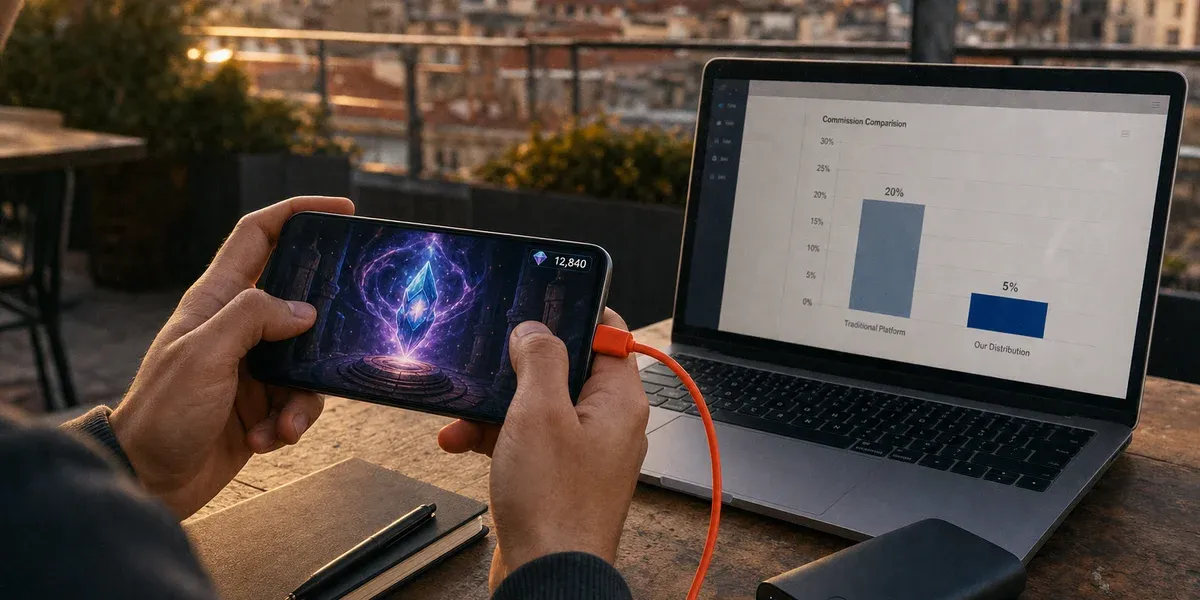
Direct answer — Is Aptoide on iOS worth it for game publishers? Aptoide is the first third-party iOS marketplace to ship an Apple-approved native in-app purchase system, and it charges 10-20% commission on IAP versus Apple’s 30% while absorbing the Core Technology Fee it owes Apple rather than passing it to users. For EU-facing games with real IAP revenue, the Aptoide iOS marketplace is a genuine margin play — but it only reaches EU iPhone users, so it complements the App Store, it doesn’t replace it.
Most coverage of the DMA and alternative iOS stores stops at “you can now sideload in the EU.” That framing misses the operationally interesting part. The thing publishers should actually care about isn’t sideloading — it’s whether a third-party store can process a real-money purchase inside your game without routing it through Apple’s 30% tollbooth. Aptoide is the first store on iOS that can, and that changes the calculation for a specific class of title. This piece is about who that title is.
What exactly did Aptoide launch on iOS?
Aptoide is the longest-standing independent Android app store, with more than 50 million monthly active users worldwide (Aptoide). It launched a third-party iOS storefront in June 2024 — a few months after AltStore PAL’s April 2024 debut, and ahead of Epic Games Store’s August 2024 launch — opening as an invite-only EU beta before rolling out across the European Union (MacRumors, Android Authority). Unlike its general-purpose Android catalogue, the iOS version is a games-only marketplace.
The part that matters for revenue is quieter. Aptoide also built “the first Apple-approved, third-party IAP software development kit (SDK) for iOS developers” (Android Authority). In plain terms: a game distributed through the Aptoide iOS marketplace can sell coins, gems, battle passes and removals-of-ads through Aptoide’s payment rail instead of Apple’s StoreKit. That is the first time on iOS that a real-money digital purchase has been legally processed outside Apple’s own billing since the App Store opened in 2008.
That native-IAP capability is the whole story. Sideloading a store onto an iPhone is table stakes now that several marketplaces do it. Being able to monetise inside that store — with Apple’s blessing, through an approved SDK — is what turns Aptoide from a distribution curiosity into a channel with a P&L attached.
The fee stack: Aptoide iOS vs the App Store
Here is the comparison a finance-minded publisher actually wants. On the App Store, a standard developer pays 30% on IAP (15% under the Small Business Program or on subscriptions after year one). Inside the EU, a developer who opts into Apple’s DMA business terms also faces the Core Technology Fee of €0.50 per first annual install above the free tier — the mechanic we broke down in what the Core Technology Fee actually costs a game studio in the EU.
Aptoide’s model is different on both axes:
| Line item | Apple App Store (EU, DMA terms) | Aptoide iOS marketplace |
|---|---|---|
| Commission on IAP | 30% (15% small-business/subs) | 10-20%, depending on whether the marketplace sourced the install (TechCrunch) |
| Core Technology Fee | €0.50 / first annual install above threshold | Aptoide operates as a free store and absorbs the CTF it owes Apple rather than passing it to users (TechCrunch) |
| Geography | Global | EU iPhone users only |
| Catalogue type | General | Games-only |
The commission delta is the headline: keeping 80-90% of IAP revenue instead of 70% is a 14-28% uplift on the same gross bookings. But the honest reading is narrower than the headline. Aptoide reaches EU iPhone users only, so this is not a replacement for App Store distribution — it’s an incremental, higher-margin surface layered on top of it. For the full picture on where alt-store margins do and don’t hold up, our state of alternative app stores in 2026 sets the wider context, and our distribution practice covers the billing and payout mechanics that sit underneath a multi-store setup.
What does the MY.GAMES deal actually signal?
The most-cited proof point that alternative distribution has grown up is MY.GAMES. In January 2025 the European publisher put two of its titles — the real-time strategy game Rush Royale and the survival shooter Left to Survive — onto Aptoide, its first distribution outside major storefronts like Google Play and the App Store (PocketGamer.biz).
Read the detail carefully, because it matters for what you conclude. That partnership is on Aptoide’s Android store, not the iOS marketplace. Rush Royale is not a small game to be experimenting with: it passed 90 million lifetime installs and over $370 million in lifetime revenue by December 2024 (MY.GAMES newsroom). When a publisher with a nine-figure-revenue live title chooses an independent store as its first step beyond the duopoly, that’s not a lab experiment — it’s a signal that the operational and commercial risk of alternative distribution is now acceptable to serious operators.
So the honest framing is this: MY.GAMES validates Aptoide as a distribution partner at scale on Android. The iOS native-IAP marketplace is the newer, higher-margin, EU-only surface from the same company. The Android deal de-risks the relationship; the iOS IAP model is the reason a publisher would specifically care about Aptoide on iPhone. Don’t conflate the two — but do read the Android commitment as evidence that the company can carry real volume.
Which studios should prioritise the Aptoide iOS channel?
Short answer: EU-exposed games where IAP is the primary revenue engine and gross bookings are high enough that a 14-28% margin uplift clears the integration cost.
Concretely, the channel earns its integration effort when:
- A meaningful slice of your revenue is EU iPhone IAP. The upside is bounded by EU-only reach. If your paying base is mostly outside Europe, or mostly Android, the commission win is small in absolute euros.
- You monetise through consumable IAP, not premium price. The 10-20% vs 30% gap compounds on high-frequency purchases (gacha pulls, currency top-ups, battle passes). A one-time paid download barely moves.
- You already run live-ops. A store with its own payment rail, its own reporting and its own promotional slots is a product to operate, not a checkbox. Teams already staffed for live-ops absorb it; a solo dev shipping and forgetting will not see the return.
The channel is a poor fit if you’re pre-launch and unproven, if your audience is US/APAC-heavy, or if your monetisation is ad-led rather than IAP-led — in that last case the commission delta simply doesn’t apply to most of your revenue. This is a deliberately different question from the generic “should I go alt-store” checklist; it’s specifically about whether Aptoide’s native-IAP economics beat your App Store status quo on the EU slice of your book.
Publishers weighing Aptoide against the other DMA marketplaces should also look at how to list before Epic’s mobile self-publishing opens and what Skich and Onside mean for publishers — the games-only positioning Aptoide takes on iOS is a pattern several stores are now converging on.
How do you list a game on Aptoide iOS?
The mechanical sequence is more familiar than the DMA headlines suggest:
- Opt into Apple’s DMA business terms. Third-party marketplace distribution in the EU requires the alternative-terms addendum in App Store Connect. This is the same prerequisite as any EU alt-store, and it has CTF implications you should model first.
- Integrate the Aptoide IAP SDK. This is the differentiator versus other stores — it’s what lets you take payment outside StoreKit. Budget engineering time for a second payment path plus receipt validation and refund handling on Aptoide’s side.
- Build and notarise an EU distribution binary. Apple still notarises apps distributed through third-party marketplaces for security and functional integrity; you ship a marketplace-targeted build alongside your App Store build.
- Submit to Aptoide and configure store presence. Catalogue metadata, pricing, and any launch promotion (Aptoide has run user-facing purchase bonuses, which shift the checkout math in your favour without touching your net).
- Instrument the channel separately. Track EU iPhone IAP through Aptoide as its own cohort. Comparing its ARPPU and refund rate to your App Store EU cohort is the only way to know whether the margin win is real net of any conversion drop.
Treat step 2 as the one that decides the project. Everything else is a variant of work you already do for the App Store; the IAP SDK is the new muscle. If you’re weighing more than one iOS marketplace, our third-party iOS marketplace checklist walks through the full entitlements-to-token sequence store by store.
What should a studio do next?
The pragmatic sequence, in order:
- Size the prize before you build. Pull your EU iPhone IAP revenue for the last 12 months. Multiply by the 10-20 point commission swing. If the annual figure doesn’t comfortably clear a few weeks of engineering plus ongoing ops, stop here.
- Model the CTF first, not last. Your own installs may carry Core Technology Fee liability under DMA terms independent of Aptoide’s store-level absorption; run that math using our CTF break-even guide before you commit.
- Pilot with one title, one cohort. Ship your highest-ARPU EU title to Aptoide iOS, keep the App Store version live, and compare cohorts for a full monetisation cycle.
- Decide on evidence, not narrative. If EU iPhone Aptoide ARPPU holds and refunds stay flat, expand. If conversion drops enough to erase the commission win, you’ve learned it cheaply.
Don’t do the opposite of any of these — don’t integrate a second payment rail on faith, and don’t treat “first third-party IAP on iOS” as a reason to ship before the numbers say so.
FAQ
Is Aptoide’s iOS marketplace available outside the EU?
No. Alternative iOS marketplaces exist only in the European Union under the Digital Markets Act. The Aptoide iOS store and its native IAP reach EU iPhone users only. Outside the EU, Apple does not permit third-party marketplaces on iPhone, so the App Store remains the only iOS distribution path.
How much commission does Aptoide take on iOS in-app purchases?
Between 10% and 20%, depending on whether the install was sourced by the marketplace or brought by the developer, versus Apple’s standard 30% (or 15% under the Small Business Program). Aptoide also operates as a free store and absorbs the Core Technology Fee it owes Apple rather than passing it to users.
Is Rush Royale distributed through Aptoide on iOS?
The publicly announced MY.GAMES / Aptoide partnership — covering Rush Royale and Left to Survive — is on Aptoide’s Android store, announced in January 2025. It is MY.GAMES’ first distribution outside major storefronts and signals that serious publishers now treat Aptoide as a real channel, but it is not an iOS native-IAP case study.
What makes Aptoide’s iOS IAP different from other alternative stores?
Aptoide built the first Apple-approved third-party in-app purchase SDK for iOS. That means a game can process real-money digital purchases through Aptoide’s payment rail instead of Apple’s StoreKit — the capability that turns a distribution channel into a margin play. Sideloading a store is now common; native, approved IAP is what’s rare.
Does Aptoide on iOS replace the App Store?
No. Because it reaches only EU iPhone users, Aptoide is an incremental higher-margin surface, not a replacement. The correct model is App Store for global reach plus Aptoide for a higher take-home rate on the EU iPhone slice of your IAP revenue.
If you’re weighing whether the Aptoide iOS channel — or any of the EU DMA marketplaces — fits your title’s economics, our distribution practice models the fee stack and the payment integration with you, and early-stage teams can start with the Founding Developer Program.
Sources
- Aptoide FAQ — company and marketplace model
- Aptoide launches its game store on iPhone in the EU
- Aptoide alternative app marketplace for games on iOS
- Aptoide partners with MY.GAMES to expand game distribution
- Rush Royale celebrates its 4th anniversary with over 90 million installs
- The alternative app stores available in the EU and elsewhere