Transsion Palmstore: Africa's default channel for mobile games
Transsion's Tecno, Infinix and itel brands took 48% of African smartphone shipments in 2025. Palmstore is their built-in store — the distribution playbook for studios.
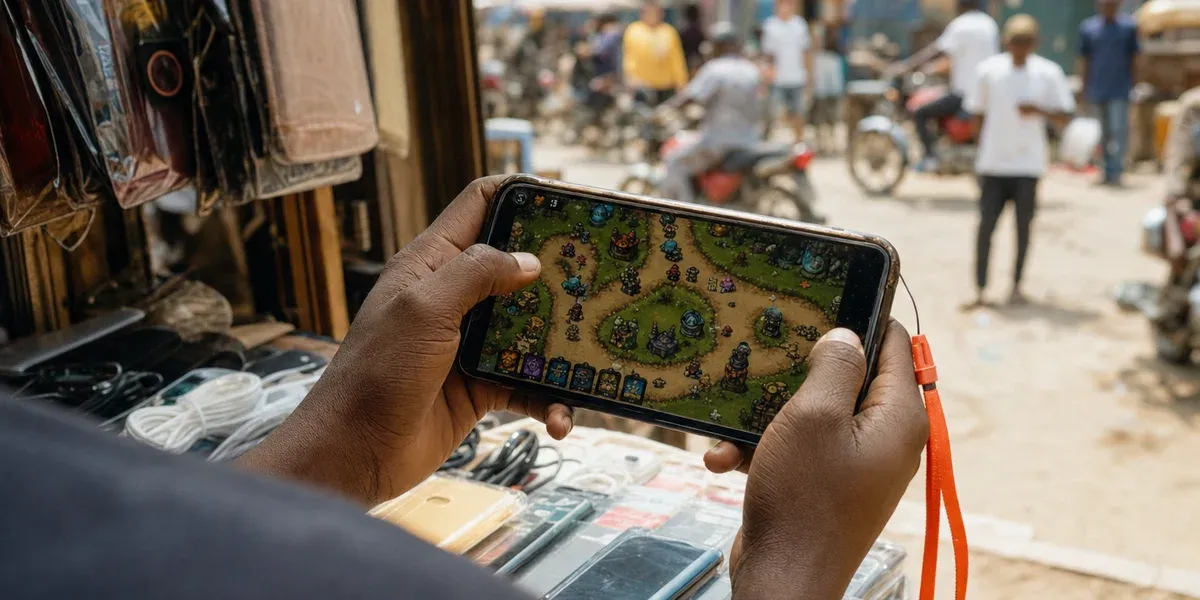
Direct answer — how do you distribute a mobile game to Africa when most devices don’t lean on Google Play? You go through Transsion. Its Tecno, Infinix and itel brands accounted for roughly 48% of smartphones shipped in Africa in 2025 (Omdia), and those devices ship with Palmstore — Transsion’s own app distribution platform — as the default store. For Transsion Palmstore mobile games distribution, that means on-device placement, preload slots and a captive discovery surface in exactly the markets where Play Store access is thin, data is expensive, and Western UA channels barely reach. Palmstore is the fourth OEM pillar most studios ignore — and the one that owns the continent.
If your distribution map for emerging markets stops at Samsung, Xiaomi and Huawei, it has a hole the size of Africa. This article is for studios and publishers deciding where to spend integration effort next: what Transsion actually controls, how Palmstore works as a channel, and the operational sequence to get a title placed. It is a distribution decision, not a market-tour read.
How big is Transsion’s Africa footprint, really?
Bigger than the three OEMs everyone benchmarks. Transsion Holdings — the parent of Tecno, Infinix and itel — shipped 40.5 million of Africa’s 84.4 million smartphones in 2025, about 48% of the market, on Omdia’s numbers. That is more than Samsung (15.3 million) and Xiaomi (10.7 million) combined on the continent.
The direction matters as much as the level, though, and it cuts against the usual telling. Transsion’s African volumes rose in 2025, from 37.9 million units to 40.5 million — but its share fell from 51% to 48%, because Samsung and Xiaomi grew faster off smaller bases. Counterpoint Research, measuring the wider Middle East & Africa region, put Transsion at 32% in Q1 2025, up from 29% a year earlier; the Africa-only concentration is higher than the blended MEA number. Read together: still dominant by a wide margin, and still growing in absolute terms, but no longer taking share in Africa itself. Plan the channel around a leader defending a position, not one running away with it.
The country-level picture is starker still. In Nigeria, the three Transsion brands together accounted for 50.69% of smartphone web traffic in February 2025 — Tecno 23.55%, Infinix 21.73%, itel 5.41% — on StatCounter data compiled by Intelpoint. Note what that measures: browsing activity by device brand, which is a proxy for the installed base actually in people’s hands, not a shipment or sales share. For a distribution decision that is arguably the more useful number, but it is not interchangeable with the Omdia shipment figures above. On price tiers, Counterpoint found itel holding a dominant 52% of the $50-$74 band across MEA in Q1 2025 — the bracket where first-time smartphone buyers enter — while struggling across most other bands.
This is not a purely African story. Transsion’s strongholds run through Sub-Saharan Africa, South Asia (India, Pakistan, Bangladesh), Southeast Asia and parts of LATAM — precisely the emerging markets where card penetration is low and paid user acquisition delivers the worst returns. That footprint is why a distribution stack that treats Transsion as an afterthought is leaving one of the largest under-contested audiences in mobile on the table — the kind of gap our distribution practice exists to close.
What is Palmstore, and how does it distribute games?
Palmstore (also written Palm Store) describes itself as the official Android app distribution platform for Tecno, itel and Infinix phones, and it ships on the handsets themselves. On phones where Google Play is absent, throttled by data cost, or simply not the habit, Palmstore is the default discovery surface — the store a user opens because it’s already there on the home screen. That is the whole value: it is OS-adjacent, preloaded, and positioned at the point of first activation.
Several properties make it a genuine channel rather than a token second store:
- Preload and first-boot placement. Transsion supports preload partnerships where an app appears during device setup, in onboarding flows, or as a first-boot recommendation — the highest-intent placement in the entire mobile funnel, because it reaches a user before any competitor does.
- Bandwidth-aware delivery. Palmstore says its package compression technology “reduces data traffic by more than 30%” — a decisive edge when a user is paying per megabyte and abandoning large installs.
- Localisation built in. The storefront runs in nine languages, matching the linguistic spread of its markets.
- Vetting and compliance. Distribution requires real-name developer verification, plus automated security checks, compatibility testing and content-compliance monitoring — friction on the way in, but the same gate that keeps the store credible for placement.
The mechanics rhyme with the big Android OEM stores, but the reach proposition is different: Palmstore is not a broader version of Galaxy Store or GetApps — it is the only default store on hundreds of millions of budget-to-mid Android devices in markets the others under-serve. If you want the head-to-head on the three OEM stores studios usually start with, we covered that in Galaxy Store vs Xiaomi GetApps vs Huawei AppGallery; Transsion is the pillar that comparison deliberately left for its own piece, because its market is different.
Where does Boomplay fit in the Transsion ecosystem?
Palmstore isn’t the only Transsion-owned surface a studio can reach players through. Boomplay — the music and video streaming service that launched on Tecno handsets and grew into one of Africa’s largest homegrown streaming platforms — ships across much of the same device base, with its audience concentrated in Sub-Saharan Africa. Published user counts for it vary widely and none we could trace back to a dated company statement, so size the opportunity from Transsion’s device footprint rather than from a headline MAU number.
For a studio, Boomplay is a complementary demand-gen surface, not a store: it runs an advertising business, meaning paid cross-promotion inventory that reaches the same Transsion-device audience Palmstore distributes to. The store handles the install; the streaming app’s ad inventory handles awareness — two ends of one ecosystem, both owned by the OEM already on the home screen. Treat specific ad products or cross-promo terms as something to confirm with Transsion’s commercial team; the point is that the reach concentrates in one partner.
Why this isn’t the Samsung/Xiaomi/Huawei playbook
Three reasons the standard OEM approach doesn’t transfer cleanly to Transsion.
Different markets. The Samsung/Xiaomi/Huawei sequencing optimises for global breadth, China/India volume, and GMS-free reach respectively. None of them own Sub-Saharan Africa the way Transsion does. If your growth thesis includes Nigeria, Kenya, Ghana, Tanzania, Ethiopia or Côte d’Ivoire, Transsion is not one option among several — it is the channel. Studios who need both Transsion and the wider Android OEM universe can pair it with an aggregator like KYLN, which bundles Samsung, Xiaomi and Huawei distribution into a single integration. The same logic runs in reverse: if the growth thesis is India or Southeast Asia instead, Transsion is a secondary player there, and vivo’s V-Appstore — which tops the India smartphone market — is the channel worth the integration effort.
Different device economics. Transsion’s base skews to budget hardware and first-time smartphone owners. Titles that assume a mid-to-high-end device, large installs, or always-on high-bandwidth connectivity will underperform. Lightweight builds, tight package sizes and offline-tolerant design aren’t nice-to-haves here; they are the entry ticket. This is the same audience where direct carrier billing outperforms cards, which is why the payment layer should be planned alongside the store, not after it.
Different deal posture. Because Transsion is regionally dominant rather than globally contested, the preload conversation is with one partner that controls the on-device real estate outright. That concentrates negotiating leverage on their side — but it also means a single relationship can unlock a continent, which is rarely true of the fragmented Western channel map.
What should a studio do next?
A concrete sequence, roughly in order:
- Qualify the market fit first. Only pursue Transsion if your title has, or wants, real audience in its strongholds — Sub-Saharan Africa above all, then South Asia and SEA. Our Southeast Asia distribution playbook covers the per-country OEM and carrier billing dynamics for studios who want to extend a Transsion push into the wider region. If your revenue is US/EU/JP-centric, this channel is a distraction, not a priority.
- Right-size the build. Audit install size and device requirements against a low-end Tecno/Infinix profile. Get the package small (Palmstore’s own compression helps, but start lean), tolerate patchy connectivity, and make sure the first session works on entry-tier hardware.
- Set up the Palmstore developer account. Clear real-name verification and the compatibility/compliance checks early — this is the step that quietly stalls timelines if left late.
- List first, then pursue placement. Get a live, self-serve Palmstore listing to prove the title runs and installs cleanly. Only then open the preload / first-boot and featuring conversation, where the real volume lives — the same logic we lay out in the OEM preload deal playbook.
- Plan payments in parallel. In these markets, carrier billing and local rails convert where cards fail. Decide the monetisation path before launch, not after your install numbers arrive without matching revenue.
- Measure incrementality, not vanity installs. The question isn’t “how many installs” but “how many paying, retained players did this channel add that Play couldn’t.” Instrument for that from day one.
When not to proceed: if your title is bandwidth-heavy, targets premium devices, or has no plausible audience in Transsion’s regions, skip it. This is a high-fit, high-reward channel — not a default box to tick.
FAQ
What is Palmstore and which phones have it?
Palmstore (Palm Store) is Transsion Holdings’ first-party app store, preinstalled by default on Tecno, Infinix and itel smartphones. On those devices — which made up roughly 48% of smartphones shipped in Africa in 2025 (Omdia) — it is the primary app discovery and download surface, particularly where Google Play access is limited or data costs make large downloads impractical. It runs in nine languages and says its package compression reduces data traffic by more than 30% in bandwidth-constrained markets.
How dominant is Transsion in Africa’s smartphone market?
Transsion’s Tecno, Infinix and itel brands together accounted for about 48% of smartphones shipped in Africa in 2025, 40.5 million of 84.4 million units (Omdia) — more than Samsung and Xiaomi combined on the continent, though its share slipped from 51% in 2024 even as volumes grew. Counterpoint Research measured the group at 32% of the broader Middle East & Africa region in Q1 2025. In Nigeria, the three brands accounted for just over 50% of smartphone web traffic in February 2025 (StatCounter data via Intelpoint), and Counterpoint put itel at 52% of the $50-$74 price band across MEA.
Is distributing on Palmstore worth it for a Western studio?
It depends entirely on where your players are. If your title targets or wants audience in Sub-Saharan Africa, South Asia or Southeast Asia, Palmstore is the single most direct route to that on-device reach, and often incremental to Google Play rather than cannibalising it. If your revenue is concentrated in the US, EU or Japan, the integration effort is better spent elsewhere. The channel rewards lightweight, offline-tolerant builds paired with local payment rails such as carrier billing.
Transsion is the OEM channel that owns the markets the standard playbooks skip. Working out whether Palmstore, preload placement and the wider Transsion ecosystem fit your titles — and negotiating the terms that actually drive volume — is exactly the channel work our Founding Developer Program and distribution practice are built for. The audience is already on the device. The only question is whether your game is on the store.