IP licensing for mobile games: what a brand deal really buys a studio
Hasbro booked $44M from MONOPOLY GO! in one quarter. What an IP licensor wants, what a minimum guarantee costs, and how a brand changes a studio's distribution.
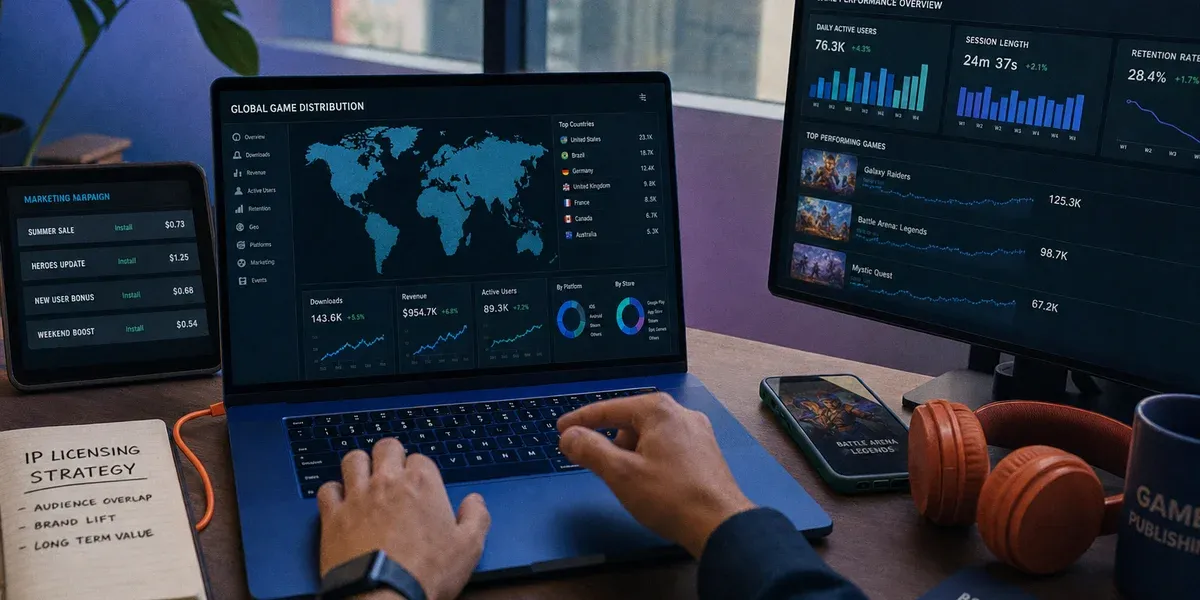
Direct answer — what does licensing an IP actually buy a mobile game studio? A licence does not hand you an audience. It buys you a reason for the people who control distribution — store editors, OEM merchandising teams, carrier partners, your own web shop — to put your game in front of one, and it buys that with a fixed cost (an advance or minimum guarantee) against variable revenue (a royalty on net receipts). So the decision is not “is this brand famous?” but “does this brand unlock a channel we cannot otherwise enter, at a guaranteed cost we survive if the collaboration underperforms?” The other side of that table is now a real P&L line: Hasbro told the SEC that MONOPOLY GO! “contributed $44 million of revenue in the second quarter” of 2026.
Most mid-size studios still file IP licensing under marketing — something a publisher pays for once you are big enough to deserve it. That framing is a decade out of date. Licensors have professionalised their games business, agents have industrialised the matchmaking, and the store machinery that decides who gets featured runs on exactly the kind of dated, merchandisable event a licensed collaboration produces.
What is a licensed mobile game worth to the IP holder?
Enough that they will take your call — Hasbro’s SEC filings put a number on it every quarter. MONOPOLY GO! “contributed $41 million of revenue in the first quarter” of 2026, then “$44 million of revenue in the second quarter”, for “$86 million” across the first half. Read the scope: that is Hasbro’s own revenue from one licensed mobile title, not the game’s gross bookings. In the same Q2 release, Hasbro reported that inside its Wizards and Digital Gaming segment “Digital and licensed gaming grew 17%” — after the same line “grew 3%” in Q1. Licensed games are a volatile, closely-watched line in a public licensor’s results, which is why its licensing team carries targets and a pipeline.
The category is also the fastest-moving part of a slow industry. Licensing International’s 2026 Global Licensing Industry Study — conducted by independent research firm Brandar Consulting on “licensing data from 1,068 companies spanning the globe” across “51 countries” — reports “$389.8 billion in global sales of licensed merchandise and services in 2025”. Licensing Source, reporting further detail from the same study, puts Software/Video Games/Apps at 11.1% of 2025 global licensing sales revenue, third-largest product category behind apparel and toys, and the fastest-growing at 12.5%.
That measures licensed merchandise and services at retail worldwide in 2025, not a mobile-games market size. What it establishes is the negotiating climate: a brand owner whose games line grows faster than its apparel line has a reason to answer a studio with two million monthly players, not only the one already banking nine figures. Which brands sit in that position, and what they need from a game, is what our interactive and brand partnerships practice works out before anyone drafts a term sheet.
What does a licensor want, and what does the deal cost?
Control first, money second. Approvals are what a licensor really sells itself internally: a named contact who signs off art, copy, store assets and marketing beats, with the right to say no late. Treat that as a formality and you will discover mid-season that your event is blocked on someone else’s legal calendar.
The money has three moving parts, and game-industry lawyer Zachary Strebeck’s published guide to licensing deal terms names them precisely. An advance is “money credited against future royalties” — it lands immediately but reduces what you earn later. A minimum guarantee is a floor: “the licensor receives the guaranteed minimum or the earned royalties, whichever is higher.” For the royalty itself, that guide tells licensees to “expect 5-15% of net receipts” on trademark and IP licensing in entertainment and gaming — a practitioner’s working range, not a measured market rate, and one that moves with the brand’s heat, the territory and any exclusivity.
The term that decides whether the deal is survivable is none of those. It is the definition of net receipts: which platform fees, payment costs, refunds, marketing and localisation you may deduct before the royalty applies. A 10% royalty on a generously defined base can cost less than 7% on a base that starts at gross. Negotiate the base before you argue about the rate.
Then be honest about the minimum guarantee, because that is where mid-size studios get hurt. A royalty is a variable cost paid out of success; a guarantee is a fixed cost you owe whether the collaboration lands or not, due on a schedule your LiveOps calendar has to hit. If you would not spend the same amount on paid user acquisition with the same certainty of outcome, do not sign it.
How does an IP change the distribution equation?
This is the part the licensing decks skip, and the part that justifies the cost. Google is blunt about the bar: “Your app or game must be good quality to be eligible for increased discovery on Google Play, and great quality to be eligible for featuring.” For a live game the route in is promotional content, and Google rations it. Game developers get “4 featuring requests per quarter” for broad audiences and “2 featuring requests per quarter” for specific audiences; events with featuring requested “must be submitted at least 14 days prior to the event start date”, and the earliest they can be submitted is “60 days before the event start date”.
A licensed crossover is structurally what that pipeline consumes: a dated event, with new art, a hook a non-player recognises, and a reason for an editor to pick you over another match-3 update the same week. That is the real mechanism by which an IP converts into distribution — not “the brand brings its fans”, which it rarely does on its own, but “the brand gives every gatekeeper in the stack something to merchandise, on a date you control, up to four times a quarter.”
The same logic runs down channels that publish no featuring calendar. OEM stores and carrier portals merchandise by recognition, and a licensed collaboration gives a regional BD contact something to take to their own editorial team — though placement terms there are negotiated per partner and never published, so treat any number quoted as deal-specific, as in our OEM preload deal playbook. Your own web shop has no gatekeeper at all: licensed cosmetics and bundles are premium SKUs you merchandise yourself, at your margin.
The licence is also a store-compliance artifact. Apple’s App Review Guidelines require that you “Don’t use protected third-party material such as trademarks, copyrighted works, or patented ideas in your app without permission”, and that “Apps should be submitted by the person or legal entity that owns or has licensed the intellectual property and other relevant rights”; for third-party services, “Authorization must be provided upon request.” A takedown mid-event costs more than the event earns, so keep the agreement, its territory and its expiry date retrievable by whoever handles store escalations.
Plan for the term ending, because it will. When EA chose not to renew the FIFA name, it announced that “Our unique licensing portfolio of more than 19,000+ players, 700+ teams, 100+ stadiums and 30 leagues that we’ve continued to invest in for decades will still be there, uniquely in EA SPORTS FC.” EA could drop one brand licence because what players came for sat in hundreds of others; a game whose identity is a single licensed brand has no such fallback.
Should you go direct, or through an agent?
Mostly a question of whether you have a business development function and a producer who can survive an approvals loop.
Yodo1’s licensing arm describes the agent model step by step: “Pinpoint ideal IPs by analyzing your game’s demographics, genre, mechanics, and monetization”, “Craft and pitch the collaboration proposal, including storyline, terms, IP items, and marketing strategy”, “Guide you through negotiations, including legal and commercials”, and “Manage day-to-day approvals for you.” It names Attack on Titan, Transformers, Dungeons & Dragons, The Walking Dead, Peaky Blinders and Pacific Rim among the brands it works with.
Read that as a job description you either outsource or staff. Use an agent when you have no relationship with rights holders, when the brand sits behind an agency you cannot get past, or when nobody internally can own approvals for a quarter. Go direct when your audience is demonstrably adjacent to the brand and you can name the executive who owns that category — direct deals also leave you holding the relationship at renewal, where the economics improve.
What should a studio do next?
Who should do this. Live-service titles with a working event calendar, an audience large enough that a two-week collaboration moves a cohort, and a producer who can be single-threaded on approvals. A game with no seasonal structure will spend the budget on a one-off art drop.
The sequence. Pick the channel you want to unlock first — store featuring, an OEM partner, your web shop — then choose the brand that channel’s merchandisers already recognise, rather than the brand your team loves. Get approvals process and territory in writing before the rate. Negotiate the definition of net receipts, then the royalty, then the guarantee, in that order. Put the featuring submission window in the plan on day one.
What to measure. Incremental payers and revenue against a matched non-event baseline, not the event week in isolation. Featuring placements actually won, by channel. Total licence cost — guarantee plus production plus approvals overhead — against that incremental revenue.
When not to proceed. If the guarantee is larger than a comfortable quarterly marketing spend, walk. If the brand’s audience does not already overlap yours, a licence buys attention you cannot retain. And if a collaboration is the only plan to fix discovery, fix the channel mix first: the ordering logic is in our multi-channel distribution framework.
FAQ
Does a licensed IP actually bring new players to a mobile game?
Less directly than the pitch implies. The reliable effect is on gatekeepers, not fans: a collaboration is a dated, visually distinct event, which is the format store featuring pipelines consume. Google states that game developers get “4 featuring requests per quarter” for broad audiences, and that events with featuring requested “must be submitted at least 14 days prior to the event start date”.
What does an IP licence cost a mid-size mobile studio?
An advance or a minimum guarantee, plus a royalty. Game-industry lawyer Zachary Strebeck’s guide calls an advance “money credited against future royalties” and a minimum guarantee a floor where “the licensor receives the guaranteed minimum or the earned royalties, whichever is higher”, and tells licensees to “expect 5-15% of net receipts” on trademark and IP licensing in entertainment and gaming — a practitioner’s range, not a market rate. The definition of net receipts decides the real cost.
Do app stores require proof of an IP licence?
Yes, on request. Apple’s App Review Guidelines state that you must not “use protected third-party material such as trademarks, copyrighted works, or patented ideas in your app without permission”, that apps “should be submitted by the person or legal entity that owns or has licensed the intellectual property and other relevant rights”, and that for third-party services “Authorization must be provided upon request.”
Is an IP agent worth the cut versus licensing directly?
It depends on your relationships and your producer capacity. Yodo1’s licensing arm describes its role as pinpointing IPs from a game’s “demographics, genre, mechanics, and monetization”, guiding “negotiations, including legal and commercials”, and managing “day-to-day approvals for you”. An agent earns its cut when you cannot get past a licensing agency or cannot staff approvals; going direct wins when your audience is already adjacent to the brand.
Whether a brand licence earns its guarantee — against the alternative stores, OEM channels and web shop already on your roadmap — is the modelling our distribution team runs with studios. Talk to us before you sign one, or start with the Founding Developer Program if channel reach is the bigger constraint.
Sources
- Hasbro Reports Second Quarter 2026 Financial Results (Form 8-K, Exhibit 99.1)
- Hasbro Reports First Quarter 2026 Financial Results (Form 8-K, Exhibit 99.1)
- Licensing International's 2026 Global Study Shows Licensing Industry's Continued Growth, Reaching $389.8 Billion in Sales
- Licensing International unveils further details from 2026 Global Licensing Industry Study
- Understanding Licensing Deal Financial Terms: A Game Industry Guide
- Create promotional content - Play Console Help
- Getting featured on Google Play
- App Review Guidelines
- EA SPORTS FC
- Unlock Brand Licensing for Mobile Games