Discord as a distribution layer: Social SDK, Game Shop and the gifting math
Discord's Social SDK is free and now on mobile; its Game Shop is still partner-only. What the Marvel Rivals gifting data does and doesn't prove for studios.
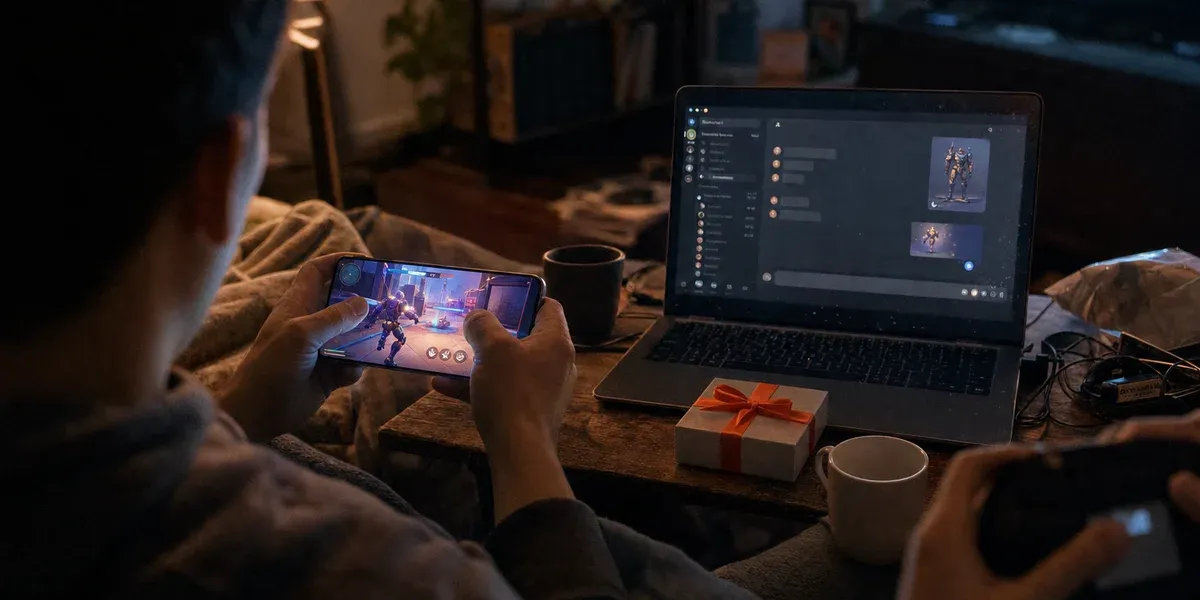
Direct answer — Is Discord a real distribution channel for game studios in 2026? Partly. The Discord Social SDK is free for any studio and, since August 2026, generally available on iOS and Android, so the social layer (account linking, friends, Rich Presence, invites) is open to everyone today. The commerce layer, Discord Social Commerce and its Game Shop, is still restricted to a select group of partners with undisclosed revenue-share terms. Treat Discord as a re-engagement and gifting channel you can test, not yet as a storefront you can model.
At GDC 2026 Discord pitched itself as “the social layer of gaming” and expanded three things studios care about: the Social SDK, a Game Shop inside official servers, and gifting of in-game items from chats and profiles. Seven months on, the announcements have aged unevenly. This piece separates what any studio can ship now from what still sits behind a partnership conversation, and looks at the one dataset Discord has published on commerce: the Marvel Rivals rollout.
What did Discord actually ship for game studios?
Four pieces, with very different access rules.
| Piece | What it does | Who can use it today |
|---|---|---|
| Social SDK | Account linking, unified friends list, Rich Presence, game invites, in-game voice and text | Any studio; Discord says it is “currently available to download from our Developer Portal at no cost” |
| Social Commerce / Game Shop | Sells and gifts in-game items from an official server’s Game Shop, DMs, voice channels and player Wishlists | ”A limited group of partners and expanding from there”; interest is submitted to Discord’s team |
| Claim your game | Verified official server and an editable game profile | Games on Steam, which Discord opened first at GDC |
| Activities | Web apps that run inside Discord, with one-time purchases and subscriptions through the Embedded App SDK | Any developer, but monetisation requires a verified app owned by a team, and Premium Apps payouts are limited to teams in the United States, European Union or United Kingdom |
The SDK is the entry point to everything else. Discord’s Social Commerce FAQ states that account linking through the Social SDK is a requirement: “Account Linking is essential for instant item delivery,” and partners “must implement” it as part of activation. In other words, the free part is also the prerequisite for the paid part, which is why studios that integrate the SDK now are effectively queueing for commerce.
Discord’s own case for the SDK is retention, not acquisition. In its GDC post it reports that, across its initial integration partners, “linked players show a median 25% increase in active game days and 16% longer session duration.” The footnote matters: that comes from Discord’s causal study of 15+ games launched since December 2024, measured on players who chose to link their accounts, so it describes the linked minority of a player base, not the whole of it.
How big is the reach, really?
Large, but the headline numbers measure Discord, not your addressable buyers.
Discord states it has more than 90 million daily active users, based on its internal data as of Q4 2025, and that over 90% of them play video games according to its 2025 user survey. Its developer documentation adds that “over 9,000 official game communities are on Discord, with over 80 million members,” citing Discord internal data for 2025.
Two scoping points before those numbers go into a business case:
- 80 million is community membership, not unique gamers. Discord counts members across more than 9,000 official game communities and does not say how many distinct people that represents. It is not a count of players “your studio isn’t reaching”; it is the population already sitting in somebody’s official server.
- Daily actives are platform-wide. The 90 million figure covers all of Discord. The share of it that would ever see your Game Shop is bounded by your own server, your players’ friend graphs and whatever discovery Discord chooses to give you.
The practical reach of Discord for a given title is therefore your community plus one hop of friends. That is a smaller number than the platform totals, and a more useful one, because it is the population the gifting mechanic actually targets. How that fits next to stores, OEM and web channels is the kind of sequencing question we work through on our distribution practice.
What does the Marvel Rivals data actually prove?
That gifting can pull lapsed and non-players into a purchase. It does not yet prove margin.
Discord’s GDC post reports that “In our rollout with Marvel Rivals, 41% of purchases were gifts,” and that “25% of those gift buyers had either never played the game or had stopped.” Its Social Commerce page adds a third figure: 12% of gift buyers “do not even play the game.” All three are Discord internal data covering December 2025 to January 2026, for one title.
Read that carefully. The 41% describes the mix of purchases made through Discord, not an uplift on the game’s total revenue. The 25% and 12% describe who the gift buyers were, not how many of them came back to play. What the data does support is the core mechanism: a purchase surface placed in conversations can sell to people your in-game store never sees. Discord frames it the same way, calling Social Commerce “incremental and complementary to your existing in-game shops and web stores.”
What the data cannot tell you yet:
- Generalisability. Marvel Rivals is a large NetEase title and the pilot for Discord’s Social Commerce rollout. A mid-size studio with a thinner catalogue and a smaller server should not expect the same purchase mix.
- Seasonality. The measurement window, December to January, spans the year-end gift-giving period. Discord has not published a comparison outside that window.
- Net economics. Discord’s FAQ answers the business-model question with “For detailed partnership terms and revenue-sharing details, connect with our team.” No public fee card exists, so you cannot yet compare Discord’s net revenue per sale against your app store or your own web shop run as a LiveOps product.
That last gap is the decisive one. A distribution channel you cannot price is a channel you can pilot, not one you can plan around.
Does any of this work for mobile games?
The SDK does. Commerce is moving there, and Discord’s own pages disagree on how far it has got.
On 6 August 2026 Discord announced general availability of mobile support in Social SDK version 1.10, with deeplinked account linking, a lighter Rich Presence setup for Android, and Tencent (Arena Breakout, Delta Force), Scopely (Marvel Strike Force) and Ninja Kiwi (Bloons TD 6) named as early partners. The same post says Discord “brought Commerce to mobile,” and Ninja Kiwi now runs a Bloons TD 6 shop on Discord.
Two qualifications, both from Discord’s own pages as of 14 October 2026:
- The Social Commerce FAQ still says “Purchasing is supported via the Discord desktop client, with plans to expand purchasing to other platforms in the future.” Item delivery is broader: Discord says it can deliver items “to users playing any platform, subject to your discretion and your game’s platform agreements.”
- The Social SDK page FAQ still lists mobile as “available for experimental use,” while the August post announces general availability.
For a mobile studio the safe reading is: account linking and social features on iOS and Android are production-ready per Discord’s August announcement; the purchase side is evolving, and buying on Discord then receiving an item in a mobile game is a cross-platform purchase your App Store and Google Play obligations still govern. Check those obligations before you treat a Discord Game Shop as a way around store billing. It is not marketed as one.
Activities are the other mobile-relevant piece. Discord’s documentation describes them as web apps that run in an iframe “in Discord on desktop, mobile, and web.” For HTML5 teams that makes Discord a distribution surface in its own right, with the monetisation constraints we covered in our HTML5 game monetisation breakdown.
Which studios should test Discord now, and how?
Studios that already have a live official server, an account system and a cosmetic economy. Everyone else should take the free layer first.
A workable sequence:
- Integrate the Social SDK and account linking. It costs engineering time, not fees, and it is the prerequisite for commerce. Measure linked versus unlinked cohorts on your own retention, rather than relying on Discord’s partner medians.
- Claim your game if you ship on Steam. It verifies your official server, which matters once you sell from it; Discord opened claiming to Steam games first.
- Apply for Social Commerce only if gifting fits your catalogue. Discord says it expects “most partners can launch within 4 to 6 weeks from kick-off to go-live,” and the technical work is an item-delivery endpoint plus catalogue formatting. Ask for the revenue share in writing before committing roadmap time.
- Measure incrementality, not gross. The question Discord’s data raises is whether gift buyers are new money or displaced purchases from your own store. Track first-purchase rate among gift recipients and lapsed-player reactivation, not just Discord GMV.
- Keep Discord inside a broader mix. Social re-engagement is cheaper than buying the same player twice, which is the argument we make for moving beyond paid UA, but it reaches players you already touched once.
When not to proceed: if your official server is small or inactive, if your items are not giftable (pay-to-win bundles, account-bound currency), or if your legal team cannot clear cross-platform purchases with your store agreements.
FAQ
Is the Discord Social SDK free?
Yes. Discord states the SDK is “currently available to download from our Developer Portal at no cost.” The cost is integration work. Commerce terms are separate and not published.
Can any studio open a Discord Game Shop?
Not yet. Discord Social Commerce, which powers the Game Shop, is open to “a limited group of partners and expanding from there.” Studios submit interest to Discord’s team, and account linking through the Social SDK is a prerequisite.
What is Discord’s revenue share on Social Commerce?
Discord has not published one. Its FAQ directs developers to “connect with our team” for “partnership terms and revenue-sharing details.” Do not model a Discord channel margin until you have those terms in writing.
Does Discord Social Commerce work for mobile games?
Partly. Discord’s August 2026 Social SDK post says it brought Commerce to mobile, and Bloons TD 6 runs a shop on Discord. Its Social Commerce FAQ, as of October 2026, still says purchasing is supported via the Discord desktop client, while items can be delivered to any platform subject to your platform agreements.
Are the Marvel Rivals gifting numbers representative?
They come from one large title over December 2025 to January 2026, measured by Discord. They show that gifting reaches lapsed and non-players. They do not show net revenue uplift or how a smaller catalogue would perform.
If you are weighing Discord against stores, OEM and web channels for your next launch, see how we build multi-channel plans on our distribution page or talk to us.
Sources
- Building on the Social Layer of Games: What's New from GDC 2026
- Discord Social Commerce
- General Availability of Mobile Platform Support Arrives in Discord Social SDK Version 1.10
- Discord Social SDK
- How Can I Grow My Game? — Discord Developer Documentation
- Enabling Monetization — Discord Developer Documentation